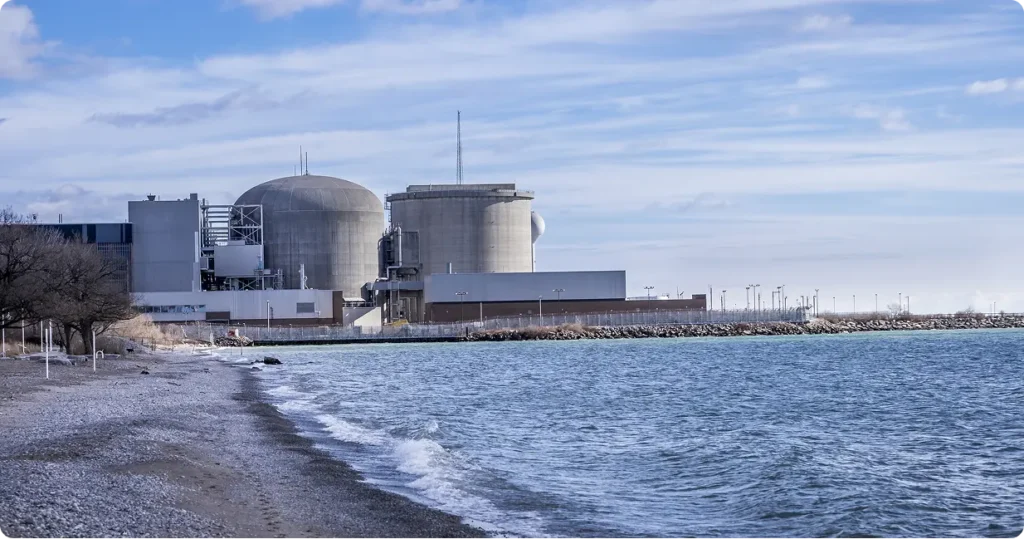


A recent C4C discussion co-hosted with Fasken, convened senior leaders from Canada’s financial, Indigenous, infrastructure and nuclear communities to consider a fundamental question: how can Canada mobilize the capital required to finance the next generation of major nuclear projects?
Moderated by W. Ian Palm of Fasken, the panel featured Michael Fedchyshyn, CEO of the Building Ontario Fund; Patrick Chabot, Managing Director, Projects and Cleantech at Canada Growth Fund; and Don Richardson, CEO of Minogi Corp.
The conversation ranged from the role of public investment and institutional capital to Indigenous ownership, project risk, regulatory certainty and the importance of building a pipeline of investable opportunities. What emerged was not a single financing solution, but a clearer view of the conditions Canada will need to create if it wants capital to participate at the scale required.

Nuclear Development, Bankability, and Risk Allocation
Canada is entering a period of substantial electricity infrastructure investment. Ontario alone is preparing for significant growth in electricity demand over the coming decades. Provincial electricity consumption is expected to rise from approximately 147 TWh today to more than 200 TWh, while peak demand could increase by 38 per cent by 2042.
Canada has deep nuclear expertise, an established and competent regulatory system, and sophisticated capital markets. But projects of this scale cannot rely on a single source of funding. They will require combinations of utility capital, governments, public investment vehicles, banks, institutional investors and Indigenous equity.
The central challenge is therefore not simply identifying capital. It is creating projects with risk and return characteristics that allow different sources of capital to participate. Capital follows clarity.
Nuclear projects combine several characteristics that can make financing difficult: significant upfront capital requirements, extended construction schedules, complex regulatory processes and years before an asset begins generating revenue.
Investors want to understand not only the potential long-term return, but who is responsible if costs increase, schedules move, or other risks materialize. That makes risk allocation central to bankability.
There is little value in nominally transferring a risk to a party that cannot realistically manage or absorb it. Doing so simply increases the price that party will charge or can prevent investment altogether. The more effective approach is to allocate risks to the parties best positioned to manage them.
Developers and contractors need incentives to deliver projects efficiently; investors require visibility into the risks they are accepting; governments may be better placed to address certain policy or black swan event risks; and consumers need protection against unlimited exposure.
The financing structure must reconcile all those objectives.
Public Capital to Unlock Private Capital
Public capital can be catalytic when it is used to address specific risks that prevent otherwise viable projects from attracting private or institutional investment. It can participate at an earlier stage, invest alongside private capital, support financing structures or provide confidence that helps other participants enter. The objective should not necessarily be for governments to finance entire projects themselves.
A more powerful measure of success may be whether public capital creates the conditions that allow significantly more private and institutional capital to follow.
Canada already has examples of this approach within nuclear: the $2-billion Canada Growth Fund equity commitment associated with Darlington and a $970-million Canada Infrastructure Bank debt commitment.
These are important signals: major public investment institutions are already participating in nuclear-related infrastructure. The next question is how those individual commitments can help evolve toward broader, repeatable financing models.
Indigenous Equity Ownership
Indigenous participation in major infrastructure is evolving. Increasingly, the industry is moving beyond consultation, benefits agreements and procurement contracts, towards equity ownership.
Ownership gives First Nations the opportunity to participate directly in the long-term economic value created by infrastructure located within or near their traditional territories.
For assets that may operate for generations, those revenues can also support long-term community development and economic self-determination. But meaningful equity participation must be considered early. If Indigenous investment is introduced only after the ownership, financing and governance structure has effectively been determined, the opportunity for genuine partnership is limited.
For nuclear projects, there is an opportunity to design Indigenous ownership into the capital structure from the outset and to consider how mechanisms such as loan guarantees and partnerships with other institutional investors can support access to competitively priced capital. Indigenous participation is a critical component of the financing model itself.

Lessons from Sizewell C in The United Kingdom
The Sizewell C project provides a useful case study of how to approach financing large nuclear in novel ways. It demonstrates how decisions about revenue, risk allocation, and government support can fundamentally change the investment characteristics of a nuclear project.
Sizewell C is a planned 3.2 GW twin-reactor project supported by the UK’s Nuclear Energy (Financing) Act. Its financing framework is based on a nuclear Regulated Asset Base (RAB) model.
Under a traditional build now, bill later approach, a project will generate little to no revenue during construction. Interest compounds over an extended period on funds borrowed to develop, investors wait years for a return, and the cost of financing can grow substantially before the plant enters service.
The Sizewell C model changes that equation in three important ways:
First, it creates cash flow during construction.
- A regulated project company is permitted to earn revenue while construction is underway. A regulated consumer charge helps fund the build, subject to oversight and consumer protections by the regulator.
- This approach significantly shortens the period during which investor capital receives no return and reduces the amount of financing cost that compounds during construction.
- The risk profile is dramatically improved for lenders and investors.
Second, it defines how cost overruns are shared.
- Rather than leaving exposure open-ended, the model establishes a framework within which investors and consumers share certain overruns up to a defined threshold.
- Sponsors remain exposed beyond the relevant cap, preserving an incentive for project owners to control costs.
- For consumers, the important principle is greater visibility. Their exposure is defined rather than becoming an unlimited and unknown obligation.
- This creates skin in the game for multiple parties while establishing clearer boundaries around liability.
Third, government supports extreme tail risk.
- There are risks that private investors cannot reasonably price without demanding an uneconomic return or declining to participate altogether.
- The Sizewell C funding structure leverages a government support package for defined tail risks that sit beyond the normal commercial risk-sharing framework.
- That sequencing is important. Government does not simply replace private capital. Instead, it takes responsibility for risks that markets may not be equipped to absorb efficiently, allowing commercial investors to price the risks they can reasonably assess and manage.
Under the RAB model, WACC was approximately 6.7 per cent, compared with approximately 9.9 per cent under a typical funding model while saving approximately $0.02 per kWh. For a large nuclear asset operating for 60 years or more, a difference of this magnitude compounds into billions of dollars of cost savings.
Ontario has the Necessary Building Blocks
Ontario has already introduced Concurrent Cost Recovery, which allows financing costs to begin being recovered during construction. Recovering interest alone does not address every element of bankability.
Equity investors still need to consider when returns begin. Construction risk still needs to be allocated. Consumer exposure still needs clear limits. Ontario also has experience with co-investment and infrastructure risk-sharing, while federal institutions have already demonstrated an appetite to invest alongside nuclear development.
The Canadian solution is evolutionary, not revolutionary.
Additional possibilities like developing construction-phase tariff mechanisms with consumer safeguards, piloting elements of a broader structure on projects already underway, defining risk-sharing arrangements in advance and positioning federal backstops behind – not ahead of – private investment.
The precise model will depend on the project, but the broader principle is valuable: the financing structure should be designed alongside the project rather than after the major development decisions have already been made.
Moving from Project Financing to a Nuclear Financing Ecosystem
The final opportunity may be to move beyond financing individual projects toward creating a financing ecosystem. Canada’s largest banks, pension funds and infrastructure investors routinely invest in major assets around the world.
A sustained domestic nuclear program could mobilize more of that expertise and capital at home. But institutional investors will need confidence that projects are structured predictably.
A visible pipeline allows financial institutions to develop internal expertise. Standardized risk allocation reduces uncertainty. Repeated construction strengthens supply chains and retains skilled labour. Regulatory and contractual familiarity can lower transaction costs. This familiarity has inherent financial value.
The same principle applies to Indigenous participation. A predictable pipeline can create opportunities for Indigenous Nations and economic development organizations to build investment capacity across multiple projects rather than approaching each opportunity in isolation.
Canada’s nuclear financing challenge is mobilizing abundant available capital under conditions that work for governments, consumers, utilities, First Nations and investors alike.
That requires more than a compelling technology or a strong long-term electricity need. It requires clear risk allocation, predictable revenue structures, disciplined project execution, strategic use of public capital, meaningful Indigenous ownership and confidence that successful approaches can be repeated.
The opportunity now is to bring those elements together. If Canada can do that, financing need not be a constraint on its nuclear ambitions. It can become one of the tools that enables them.